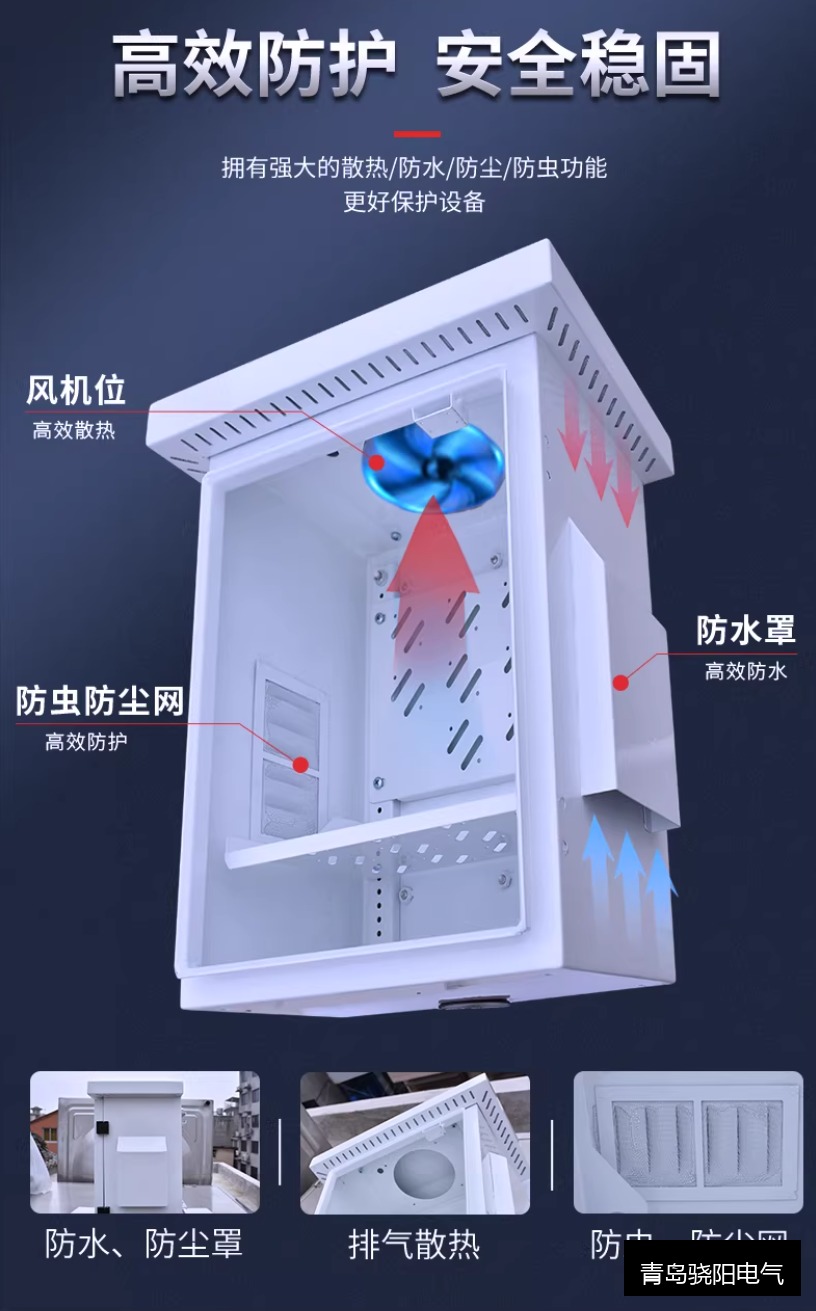
The design challenge outdoors
An outdoor distribution box sits in the open year after year, facing rain erosion, direct sunlight, temperature swings, dust and insects. A good unit has to meet its electrical requirements and must also achieve all-weather protection through its structural design. Drawing on years of cabinet manufacturing, Qingdao Xiaoyang Electric has built a mature design system for outdoor enclosures.
Our design principle
Our outdoor boxes follow a simple order of priorities: protection first, heat management alongside, workmanship throughout.
- Protection first: IP65 as the baseline, so rain and dust cannot reach the interior
- Heat management alongside: active and passive cooling combined, so internal temperature does not shorten component life
- Workmanship throughout: from material selection to welding and coating, every step has a written quality standard
The four protection layers
Layer one: water
The enclosure uses a dual-layer rain hood whose slope drains water quickly with no pooling. An EPDM rubber gasket runs around the door frame; it resists ageing and stays elastic, so the door seals fully when closed. Cable entries at the bottom use waterproof glands, so bringing a cable in does not break the rating.
- Rain hood: 15° slope for natural drainage
- Gasket: EPDM, elastic from -40°C to +120°C
- Cable entries: IP68 glands, multiple sizes
- Door: three-point locking, even sealing pressure
Layer two: heat
Under direct summer sun the interior of an outdoor box can run 15 to 20°C above ambient. Our design combines active and passive cooling:
- Active: a thermostat-controlled axial fan at the top starts above 40°C and stops below 35°C, saving energy and extending fan life
- Passive: louvred vents on both sides work with internal ducts to create natural convection
- Insulation: an insulating layer under the roof reduces radiant heat transfer
- Monitoring: an optional temperature and humidity controller tracks the internal environment
Layer three: dust and insects
Vents are the weak point of any enclosure, so every vent carries a dual-stage insect and dust filter:
- Outer stage: stainless steel mesh, blocks large insects and debris
- Inner stage: high-density filter media that traps dust particles and can be cleaned or replaced
- Quick release: removable for cleaning without tools
Layer four: structure
The body is cold-rolled steel, 1.5 mm for the shell and 2.0 mm for the mounting plate. Surfaces go through acid pickling, phosphating and electrostatic powder coating at 60 to 80 µm, and pass more than 500 hours of salt spray testing.
- Material: Q235 cold-rolled steel, or 304 stainless on request
- Finish: outdoor-grade powder coating, UV stable, non-fading
- Mounting: wall, floor-standing or pole
- Earthing: body bolt plus earth bar for electrical safety
Electrical design points
The electrical design has to account for the environment as well:
- Derating: breakers and contactors are selected at 80% of rating for high-temperature operation
- Moisture: critical components receive a conformal coating against condensation corrosion
- Heating: anti-condensation heaters are available for humid sites
- Surge protection: an SPD at the incoming supply handles induced surges
- Wiring: power and signal separated, trunking covers fitted, identification complete
Typical applications
| Application | Environment | Recommended build |
|---|---|---|
| Municipal street lighting | Open air, wide day-night swing | IP65 + thermostat cooling + timer/photocell control |
| EV charging support | Open air, heavy rain | IP65 + surge protection + earth leakage protection |
| Landscape lighting | Parks and plazas, dust | IP65 + dust filters + DMX control |
| Temporary site power | Frequent moving, vibration | IP54 + reinforced structure + socket box |
| Water treatment | High humidity, corrosive gas | 304 stainless + anti-condensation heating |
| Oil and petrochemical | Explosion-proof requirement | Ex enclosure + pressurised ventilation |
Quality control and testing
Every outdoor box is tested before it leaves the plant:
- Ingress testing: IP water spray simulating heavy rain
- Electrical testing: insulation resistance, dielectric strength, earth continuity
- Burn-in: 72 hours energised with temperature rise monitored
- Appearance: coating adhesion, thickness and colour consistency
- Function: every component operated and every connection checked
Closing
Outdoor box design is a balancing act: water against heat, protection against serviceability, cost against reliability. With 15 years in the industry, Qingdao Xiaoyang Electric provides everything from concept design to delivered product, and every box is built to take both weather and time.
For a custom outdoor distribution box, send your CAD dimension drawing and specification to our engineering team.