Overview
Outdoor control cabinets operate for years in complex outdoor conditions, and their structural design directly determines the ingress rating, cooling efficiency and service life. Based on years of outdoor cabinet manufacturing, Qingdao Xiaoyang Electric uses a modular split structure that divides the cabinet into independent functional modules, preserving protection while simplifying production, assembly and on-site maintenance.
The exploded view
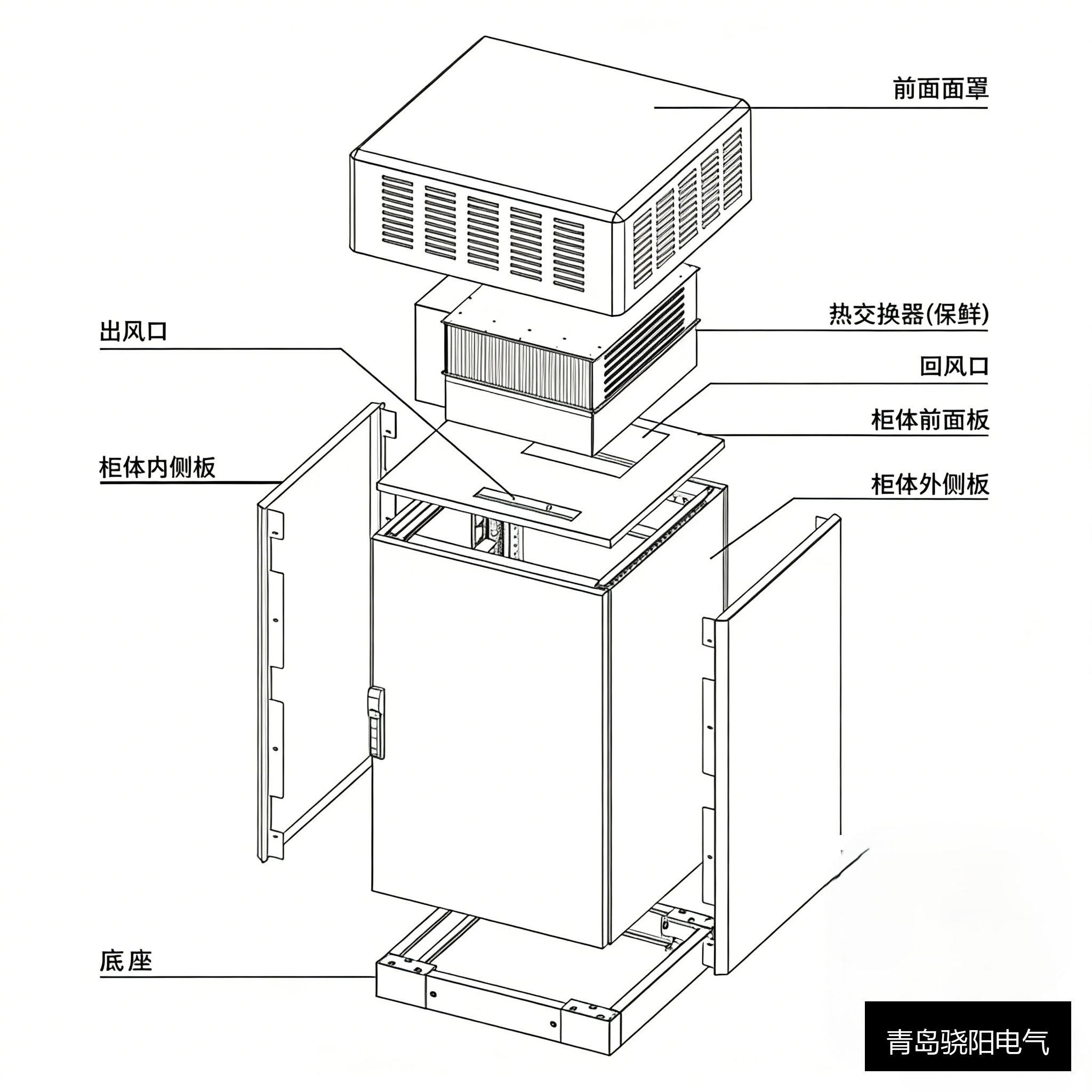
The image above shows the exploded structure of a Xiaoyang outdoor cabinet. From top to bottom: front hood, heat exchanger, cabinet front panel, inner and outer side panels, and base. Each module is formed separately and joined on site with bolts and gaskets, so the assembled unit reaches IP55/IP65.
What each part does
1. Front hood
The front hood is the outermost protection layer. Its sloped rain roof drains water quickly without pooling, and its edges turn down into a drip lip that stops water running down the cabinet face into the door seam. Between hood and cabinet sits a labyrinth seal, so even driven spray does not reach the interior.
- Material: 1.5 mm cold-rolled steel, electrostatic powder coated
- Function: rain, dust and UV protection
- Sealing: labyrinth structure plus EPDM gasket
2. Heat exchanger
The heat exchanger is the core cooling component. It works on an air-to-air principle: internal air is fully isolated from external air, and heat passes through aluminium fins. Cooling efficiency is maintained without breaking the ingress rating, because dust and moisture never travel with the air.
- Core: aluminium fins, high heat transfer efficiency
- Two circuits: independent dual fans, air fully isolated
- Control: internal temperature sensor starts the unit above the set point
- Protection: exchanger itself IP54, IP55 together with the cabinet
- Advantage: no condensate, low power draw, maintenance-free compared with air conditioning
3. Exhaust and intake
The exhaust and intake form the internal air path:
- Exhaust: at the top, hot air leaves upward
- Intake: at the bottom, cool air enters
- Ducting: internal baffles route air across every heat-generating component, with no dead zones
- Filters: washable filter media at both openings, cleaned on a maintenance schedule
Bottom-in, top-out follows the natural rise of hot air and, with the heat exchanger, closes the cooling loop.
4. Front panel
The front panel is the operating and display interface:
- Meter window: for voltmeter, ammeter and temperature controller
- Pushbuttons: pre-cut openings for emergency stop, start and stop
- Locking: three-point mechanism for even sealing pressure
- Earthing: braided strap between panel and body for electrical continuity
5. Inner and outer side panels
Xiaoyang outdoor cabinets use a double-wall side structure:
- Outer panel: load bearing and protection, 1.5 mm, powder coated
- Inner panel: component mounting, 2.0 mm, galvanised against rust
- Cavity: a 20 mm air layer between them acts as thermal insulation
- Mounting rails: 19-inch rails as standard, custom rails on request
- Wiring trunking: reserved inside the panel, power separated from signal
The double wall adds strength and blocks external heat transfer: under direct summer sun the interior runs 5 to 8°C cooler than a single-wall cabinet.
6. Base
The base is the mounting foundation:
- Raised: 100 to 200 mm height keeps ground water out
- Channel steel: fully welded, high load capacity, suited to floor mounting
- Cable entries: multiple openings with waterproof glands
- Fixing: anchor bolt holes at the four corners
- Corrosion: additional coating on the underside where it meets the ground
How the cooling system works
The cabinet combines heat exchanger and natural convection:
- Below 35°C: natural convection and cabinet conduction are enough; the exchanger stays idle
- 35-45°C: the exchanger runs on one fan to hold internal temperature
- Above 45°C: both fans run at full speed for maximum transfer
- Above 55°C: an auxiliary air conditioner can be added
The control system runs automatically with no operator input, protecting equipment and saving energy.
Ingress ratings and test results
| Test | Standard requirement | Measured |
|---|---|---|
| Dust | IP5X/IP6X | IP65 (dust-tight) |
| Water | IPX5 (low-pressure spray) | IPX5 passed, IPX6 optional |
| Salt spray | 240 hours | 500 hours, no corrosion |
| Temperature rise | Interior ≤ ambient + 15°C | Interior ≤ ambient + 10°C |
| Vibration | GB/T 2423 | Passed, no component loosening |
Applications
- Telecom sites: outdoor cabinets, BBU cabinets, power cabinets
- Intelligent transport: signal controllers, enforcement and camera cabinets
- Municipal: street lighting control boxes, landscape lighting control boxes
- Industrial automation: outdoor PLC cabinets, VFD cabinets
- New energy: PV combiner boxes, energy storage converter cabinets
- Oil and petrochemical: outdoor instrument cabinets, explosion-proof junction boxes
Custom build
Xiaoyang provides a full custom process:
- Requirement review: our engineers review the site environment, equipment list and cooling load
- Design: 3D structure, thermal calculation and bill of materials
- Prototype: first unit supplied for customer testing
- Production: manufactured under ISO 9001
- On site: installation guidance and commissioning support available
Need a custom outdoor control cabinet?
Phone: +86 185 6182 1565 | Email: lqs@qdxiaoyang.com